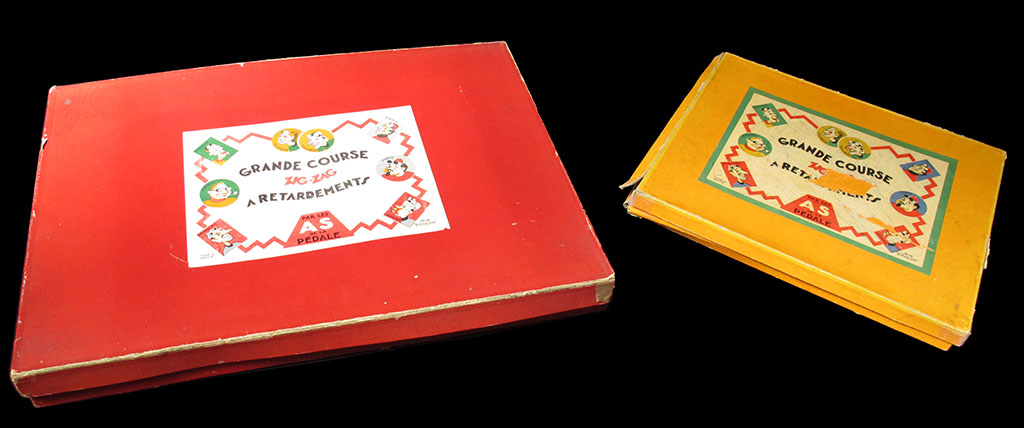
GRANDE COURSE ZIG-ZAG
À RETARDEMENTS
Sicolor, France,
1950s
Humorous French game. It looks like a kids' game, but it might not qualify as one, at least with present standards. Players bet (supposedly with chips, not with real money), and the board contains more mentions of alcoholic beverages than you would expect to find in a children's game these days (which is somewhere between "zero" and "none"). Of course, times change, and what is unacceptable nowadays may not have been so in mentally healthier times.
There are several versions of this game. The bigger red box, which belonged to François Cardinet, is quite rare and is some sort of "de luxe" version. The smaller box is the one you are more likely to find. The one shown here was part of Pierre & Bilou's collection, and it looks like its former owner did not like the label on it (or maybe he/she liked it too much). There is at least a third version of the game (see below).

There are four different starting points on the board, which is quite sensible since the riders are quite big. However, this makes the race more similar to the Monte Carlo rally than to the Tour de France. Players use coloured dice, with which they either advance one or two towns, get blocked, or pay a chip. The first player to reach Paris gets the contents of the pot.

The big "de luxe" box measures 55 x 10 x 5.5 cm, and it contains a 38 x 38 cm (not folded) board, one coloured die per player, coloured dice shakers, and a small bowl for the fines that the players have to pay during the game and that will eventually make up the winner's pot. There are also nine figurines, eight riders and one barrier, 7 cm high, though the rules only mention one rider per player.

In the smaller box there is only one coloured die, one die shaker, and fewer chips representing game money. The board is also smaller, 31 x 31 cm. However, there are still eight riders and a barrier, identical to those present in the big box, although this box is too small to hold the riders in what is supposed to be their compartment (at the left of the board in this picture); I keep them hidden under the board. I even considered the possibility that this box was originally devised to store only four riders, since that is what the rules mention. However, there are eight riders pictured on the board, and every copy I have seen of this game has the eight riders (and, of course, the barrier).
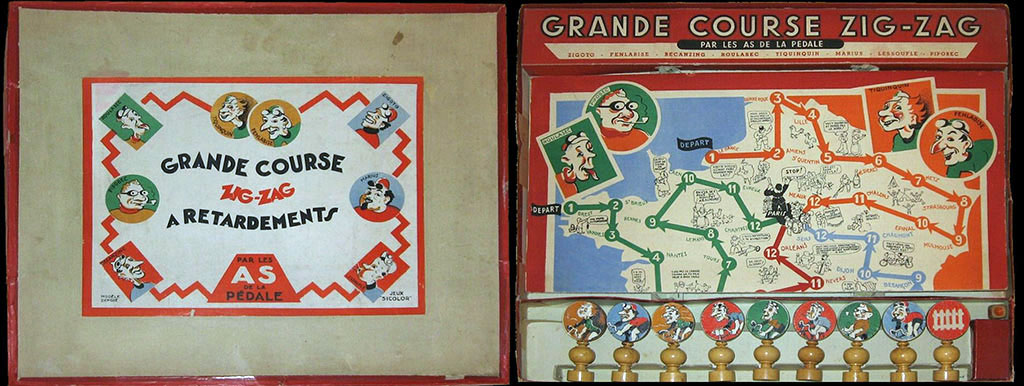
The rules are glued below the boxes' lids. They are identical in both boxes.
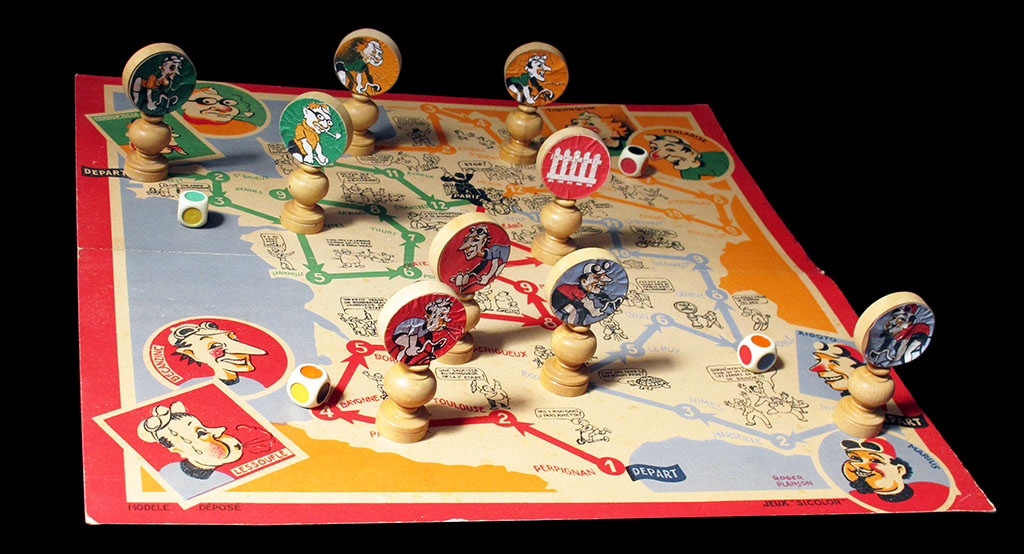
Since the cyclists are quite oversized, starting at different ends of the board helps. They could hardly have shared the same road.
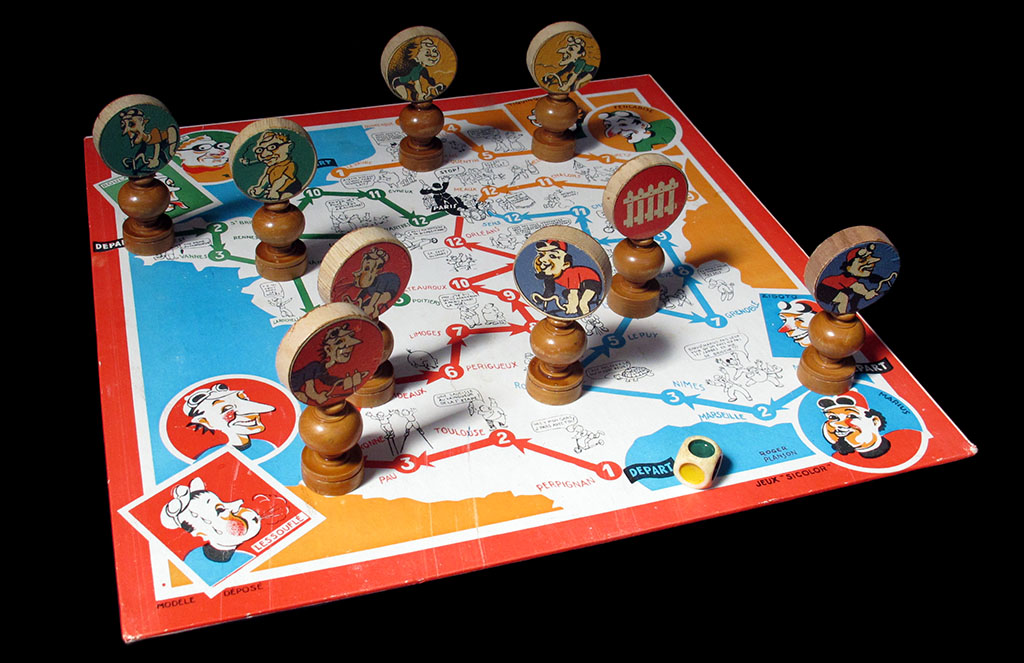
Even on the smaller board there is room to play with eight riders.

A weird detail is that the name of one of the riders is missing on the smaller board.
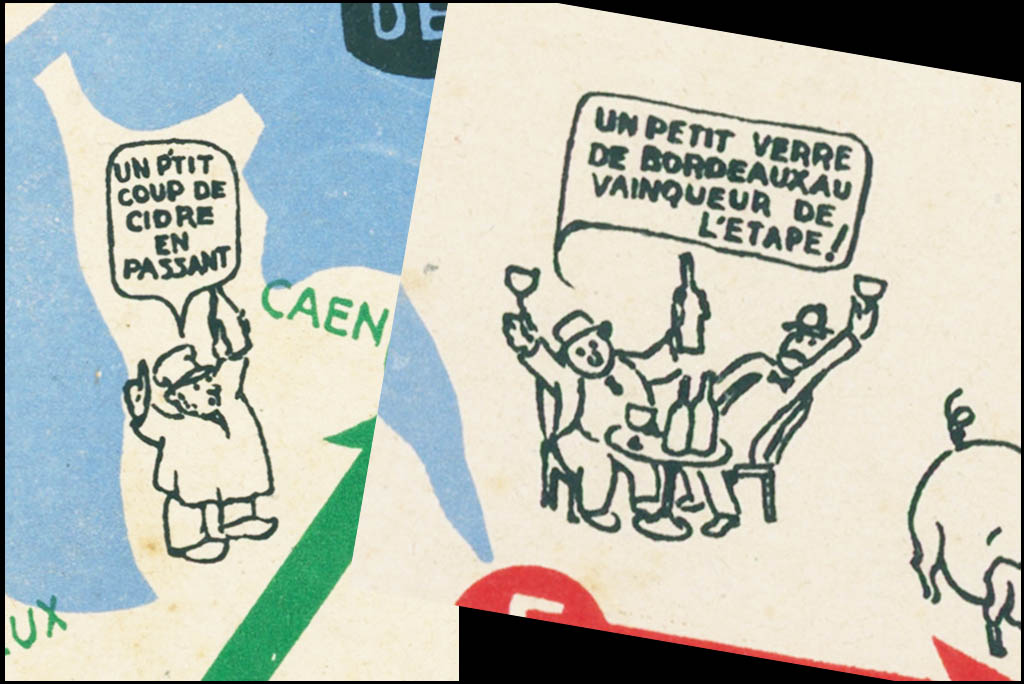
A choice of alcoholic beverages.
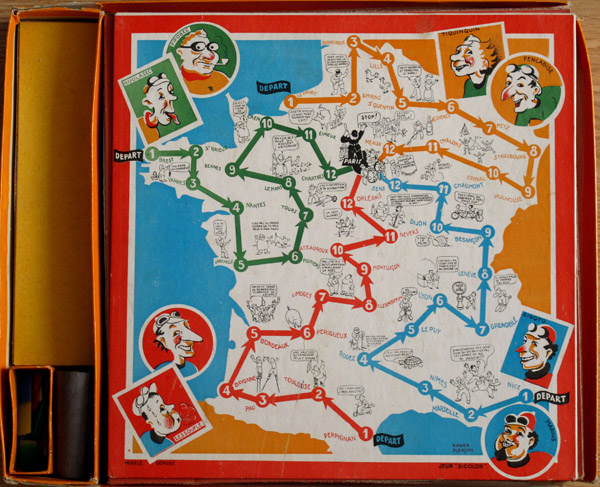
I have not found much on Roger Planson, illustrator of this game.
Here is a third box, with a two-fold board and a different in-box organization, from the collection of Didier Maria. Though the box is quite rare, the two-folded boards are less so. I myself have a couple of spares. They measure 38 x 38 cm, like the one found in the big box, and if you have a close look, you will discover that I used one of them to take some of the pictures.
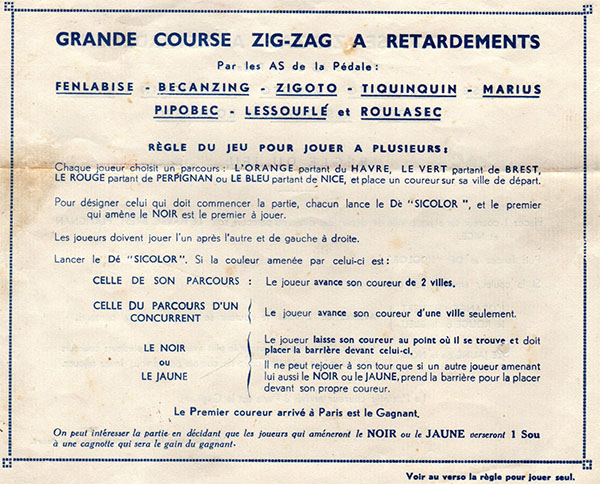
You cannot see it on the picture above, but the board has all eight names. What is strange in this version of the game is that the rules are different from those in the other boxes.
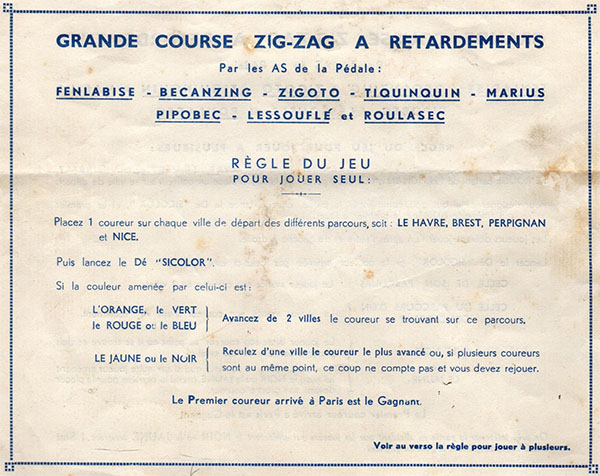
On one side we have multiplayer rules that are different from the ones in the other boxes.
On the other side of the rules sheet we found rules for solo playing.
In these rules (both for solo play and for multiple players), cyclists move if the special "sicolor" die throw matches their colour. Since there are only cyclists of four colours, the other two colours are bad throws carrying some kind of penalty. In the most common rules, however, the colour of the die throw has no relation whatsoever to the cyclists' colour.I do not know which were the original rules. What I can tell is that these rarer rules are obviously more elegant (with the other rules, one wonders what is the use of having a colour die in the first place). My guess is that these are the original rules, and therefore Didier's box would be the first version of the game, but further research is needed to be sure.
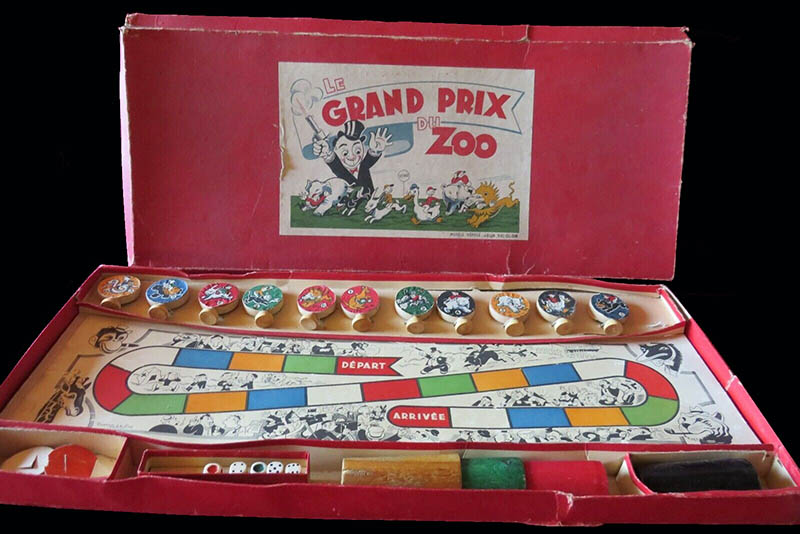
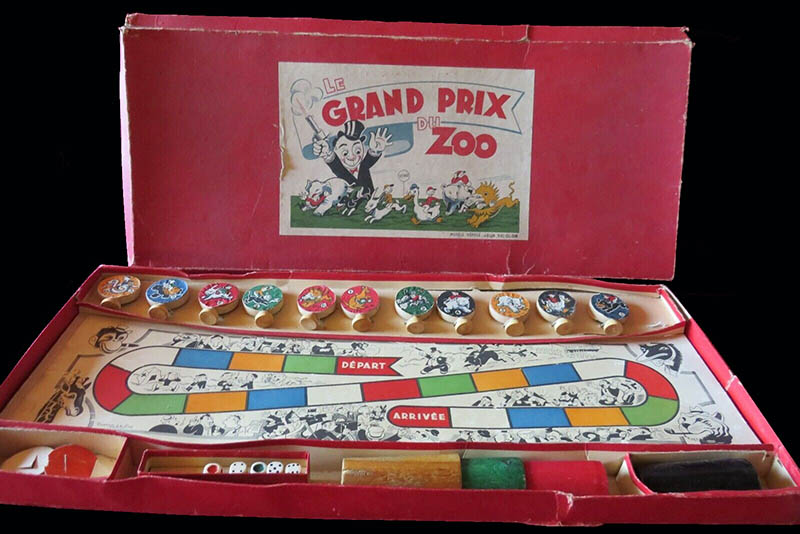
Caspar Mol from Utrecht sent this picture of another game by the same maker. He is looking for more information on Jeux Sicolor. To make a long story short: Caspar started a site on Mobaco, a Dutch construction toy. While researching the origins of Mobaco, he discovered L’Édifice, a similar French game, and he decided to start a website on that one too (still under construction), documenting the toy in all its details before the information is lost. It turns out that the makers of L'Édifice, Méricant, also made a game called Le Sicolor, so now Caspar would like to find out whether there is a relation between Jeux Sicolor and Méricant. He thinks there might be a connection, while my first guess (just an intuition, actually) is that there isn't. Any information will be welcome.
Thanks, Bilou and Mathilde, for these games.
Thanks Didier for sending pictures of yours.
Description rewritten in July 2026.
 |
 |
 |
 |
 |
|
CULTURE IDEAS |
TOTUM REVOLUTUM THUMBNAILS |
NAMES ALPHABETICAL |
CATEGORIES LISTS |
WHAT'S NEW BLOG |